What Is Local SEO? A Complete Guide to Ranking Your Business on Google
Local SEO (Search Engine Optimization) is the bridge between what people search for and the businesses that provide the best local answers. Whether you are a family dentist, an endodontist, or an orthodontist, Local SEO helps you appear exactly where your audience is looking, on Google Maps and local search results.
Think of Local SEO as a way to make your business more visible online in your own city.
It helps search engines read, understand, and recommend your business pages to nearby users who are most likely to visit, call, or book your service.
In 2026, ranking locally on Google isn’t about stuffing keywords like “dentist near me” or “ dentist in Houston.”
It’s about building trust, showing expertise, and proving that your business genuinely serves the local community.
This guide walks you through every pillar of Local SEO, from the technical foundation to AI-driven ranking factors, with clear examples from Local SEO and Dental Marketing projects I have personally worked on.
What Is Local SEO (Definition for Beginners)
Local SEO is the process of optimizing your online presence so your dental office appears higher in Google’s local results and map pack when people search for services in your area.
When someone types “dentist near me”, “pediatric dentist NY”, or “best dental implants in London,” Google analyzes hundreds of signals, including your Google Business Profile (GBP), website content, local citations, and customer reviews, to decide which businesses to display.
Local SEO helps you align with those signals by:
- Optimizing your GBP listing
- Building consistent NAP (Name, Address, Phone) across the web
- Creating location-based service pages
- Earning reviews and backlinks from trusted local sources
The goal is simple:
Rank higher for local keywords, attract nearby patients, and turn searches into calls, visits, and appointments.
Unlike traditional SEO, which targets national or global audiences, Local SEO focuses on visibility within a specific city or region, so you dominate your local market, not the whole internet.
Why Local SEO Matters More Than Ever in 2026?
Every day, over 8.5 billion searches take place on Google. That’s 8.5 billion opportunities for businesses to connect with potential patients. Organic search accounts for around 53 percent of all website traffic.
Even with the rise of social media and AI chatbots, search remains the dominant channel for discovery. For local businesses such as dental clinics, Local SEO is the key driver of walk-in and call-based leads. Patients no longer flip through directories; they simply type or voice search “dentist open now” and pick from the top results.
Paid ads can help you get instant visibility, but the moment your budget ends, so does the traffic. Strong Local SEO keeps bringing you visitors day after day without additional ad spend.
In short:
Good Local SEO equals sustainable visibility + trust + lower acquisition cost.
How Search Engines Work
Understanding how Google and Bing read your website is the foundation of every Local SEO strategy.
Search engines follow four major stages:
- Crawling – Bots (discover new or updated pages through links and sitemaps).
- Rendering – They process HTML, CSS, and JavaScript to see how the page looks.
- Indexing – Relevant pages get added to Google’s database of trillions of URLs.
- Ranking – Algorithms compare signals (content, speed, backlinks, UX) to decide which pages appear first.
If your site is not crawlable or mobile-friendly, search engines can’t rank it, no matter how good your content is.
That’s why technical health is step one in any Local SEO campaign.
Local SEO vs SEM vs PPC
Many new marketers use these terms interchangeably, but they represent different approaches.
| Aspect | Local SEO | SEM | PPC |
| Meaning | Organic optimization | Local SEO + Paid Search | Pay-Per-Click Ads |
| Cost | Free clicks (after optimization) | Mixed | Pay for each click |
| Speed | Slow to build, long-lasting | Balanced | Instant but short-term |
| Goal | Sustainable visibility | Full search coverage | Immediate traffic |
| Example | Ranking a dental site for “invisalign near me.” | Local SEO + Google Ads combo | Ads for “emergency dentist Sharjah.” |
Simple analogy: If Search Marketing is a coin, Local SEO is one side, and PPC is the other. You need both for balance, Local SEO for trust, and PPC for speed.
Core Benefits of Local SEO
- Trust & Authority: Users trust organic results more than ads.
- Sustainability: Traffic continues even after the budget ends.
- Brand Visibility: Top rankings equal brand awareness.
- Better ROI: Organic leads often convert higher because intent is stronger.
- Data Insights: Local SEO reveals what your audience really searches for.
Local SEO in Action – Dental Clinic Example
A US-based dental practice was struggling to appear for local keywords like “root canal specialist near me” or “dentist in [City].”
Their website loaded slowly and lacked structured service pages.
After a complete Local SEO overhaul:
- Implemented HTTPS and fixed mobile layout.
- Created individual pages for each service.
- Added FAQ schema and Google Map embed.
- Collected 20 new Google reviews in 3 weeks.
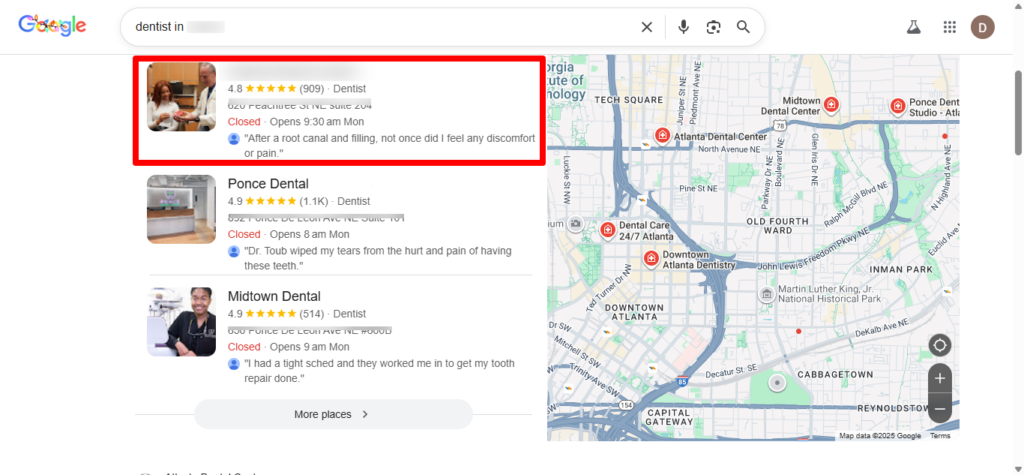
Result: Ranked top 3 in the map pack and grew calls by 64% within 90 days.
That’s the impact of local SEO done right: real patients, not just page views.
Three Pillars of Local SEO Success
To rank higher in your city, you need to build your Local SEO strategy on three strong pillars: Relevance, Proximity/Distance, and Prominence.
These are the same core factors Google uses to decide which local businesses appear in search results and map packs.
1. Relevance – Matching What People Search For
Relevance means how well your business matches what someone is looking for. Google needs to understand your services, products, and expertise clearly.
How to improve relevance:
- Add complete details to your Google Business Profile (GBP), i.e, categories, description, services, and geo-tagged images.
- Create location-specific pages (e.g., “Dental Implants in Frisco”).
- Use natural language and keywords that real people use (like “teeth cleaning near me” instead of “oral hygiene procedure”).
- Answer common local questions through blog posts and FAQs.
2. Proximity/Distance – How Close You Are to the Searcher
Distance is about proximity, how near your business is to the person searching. Even if your SEO is perfect, Google will often show the closest options first.
How to improve distance signals:
- Keep your address consistent across your website, GBP, and directories.
- Embed a Google Map on your contact page.
- Use phrases that mention your service area, such as neighborhoods or districts (“Serving North London and nearby areas”).
You can’t control where someone searches from, but you can help Google understand your location better.
3. Prominence – Building Your Reputation Online
Prominence is how well-known and trusted your business appears online.
Google measures this through reviews, backlinks, mentions, and overall engagement.
How to boost prominence:
- Collect genuine Google reviews and reply to them regularly.
- Earn backlinks from local news sites, blogs, or community pages.
- Stay active on social media and share local updates or offers.
- List your business on trusted directories (Yelp, Healthgrades, Bing Places).
The more positive signals you send, reviews, mentions, and consistent NAP, the stronger your authority becomes.
Ready to Rank Higher in Your City?
Build strong relevance, proximity, and prominence to attract more local customers from Google.
Types of SEO
Every effective SEO strategy depends on three core types:
Technical Optimization, On-Page Optimization, and Off-Page Authority.
Technical SEO – Build a Strong Foundation
Technical SEO ensures your site can be crawled, indexed, and loaded quickly.
It also creates a positive experience for visitors.
Key Technical Tasks:
- Implement HTTPS and SSL certificates.
- Fix 404 errors and redirect loops.
- Submit XML sitemaps in Search Console.
- Optimize Core Web Vitals (LCP, FID, CLS).
- Add structured data (schema).
- Ensure mobile-first design.
- Use clean, descriptive URL structures.
💡 Tip: When I optimized a Boston dental website’s speed from 5 seconds to 1.2 seconds, organic traffic rose by 38% within a month.
On-Page SEO – Your Content Engine
On-page SEO is about matching search intent and delivering value.
Each page should focus on a single topic or service and use keywords naturally.
Checklist:
- Use the primary keyword in the title, URL, H1, and intro paragraph.
- Add secondary keywords in subheadings.
- Write short paragraphs (2–3 lines).
- Include original images and alt text.
- Link internally to related pages.
- End with a strong CTA (Call to Action).
Example: A “Teeth Whitening” page can link to “Aftercare Tips,” “Cost,” and “FAQ” sections to increase session duration and CTR.
Off-Page Local SEO – Earn Trust and Authority
Off-page Local SEO extends beyond your website.
It focuses on building credibility through backlinks and brand mentions.
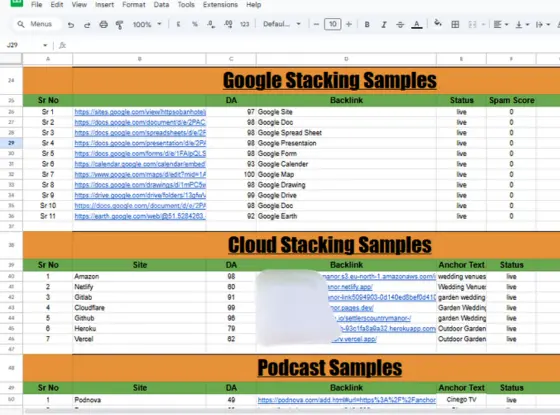
Strategies that work in 2026:
- Guest post on industry blogs.
- Most importantly, “niche edits.”
- Partner with local news outlets.
- Create citations in directories (Yelp, Healthgrades).
- Encourage reviews on Google Maps.
- Participate in community events to gain local press.
- Create Google Stacking.
- Make Podcast Backlinks.
- Build high-quality cloud stacking.
Remember: Link quality is more important than link quantity.
One mention from a local health portal can outweigh hundreds of generic blog links.
Local SEO and User Experience (UX)
Google’s algorithms increasingly measure how users interact with your site.
If visitors bounce quickly or struggle to navigate, rankings drop.
Focus on:
- Clear navigation menu.
- Readable fonts and contrast.
- No intrusive pop-ups.
- Fast loading on mobile.
- Easy contact options (phone number, form, chat).
For local businesses, adding a visible “Call Now” button on mobile alone can raise conversion rates by 15-25%.
Understanding Search Intent
Not every search is equal. You must match content to the user’s intent.
| Intent Type | Example Query | Best Content Type |
| Informational | “How to whiten teeth safely.” | Blog post / Guide |
| Navigational | “Colgate official website” | Brand homepage |
| Transactional | “Book dental cleaning near me” | Service page + CTA |
| Commercial Investigation | “Best teeth whitening treatments 2026” | Comparison article / Reviews |
Rule of thumb:
Create content for people, not for algorithms.
If your page solves a problem clearly, Google will reward it.
Local SEO — Winning in Your Own City
Local SEO is one of the most practical forms of SEO.
It helps businesses appear when people nearby search for your services.
Think: “dentist near me,” “plumber open now,” “best café in Manchester.”
For service providers, especially dentists, local SEO is your lifeline.
If your business isn’t visible in the Google Map Pack, you’re losing potential patients every single day.
Key Components of Local SEO
1. Google Business Profile (GBP):
Claim and verify your profile, then fill it out completely, including categories, hours, phone number, services, and photos.
Add regular posts to keep it active. A completed profile can get up to 7× more clicks than an empty one.
2. NAP Consistency:
Your Name, Address, and Phone number must match exactly everywhere on your website, directories, and social media. Even small mismatches like “Street” vs. “St.” can confuse Google’s local algorithm.
3. Local Citations:
Submit your business to local directories such as Yelp, Yellow Pages, Healthgrades, and Bing Places. Each listing reinforces your credibility.
4. Reviews:
Ask happy clients to leave authentic reviews. Respond to every review, positive or negative. Google uses review activity as a trust signal.
5. Local Content:
Create blog posts and pages mentioning your city or neighborhood. Example: “Best Dental Implant Options in London 2026 Update.”
Local SEO Case Study – Dental Clinic Example
Problem:
A clinic in Dubai was ranked only for its brand name. It had no presence for “dental clinic Dubai” or “veneers near me.”
Process:
- Claimed and optimized their Google Business Profile.
- Added localized service pages (e.g., /veneers-dubai/).
- Collected 35 new reviews in 60 days.
- Built 20 new citations with identical NAP.
- Linked every location page from the homepage and footer.
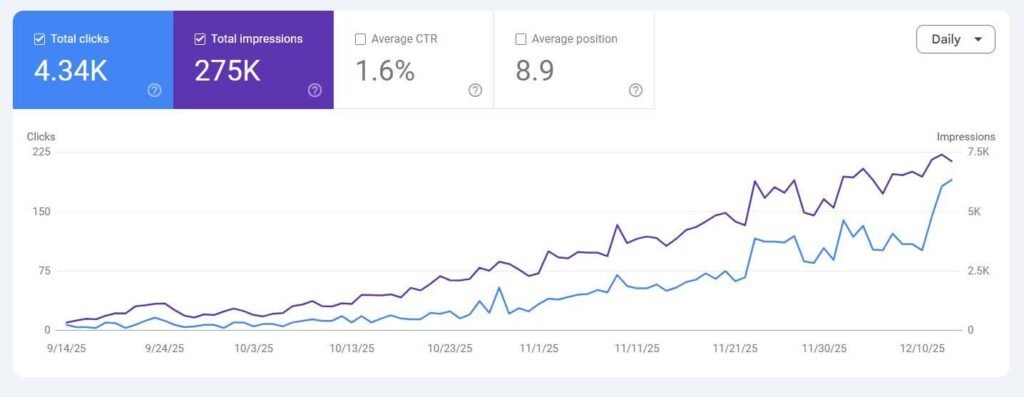
Result: Within 90 days, impressions in Google Maps jumped 190%, and monthly calls increased from 87 to 220. That’s the direct ROI of consistent local SEO work.
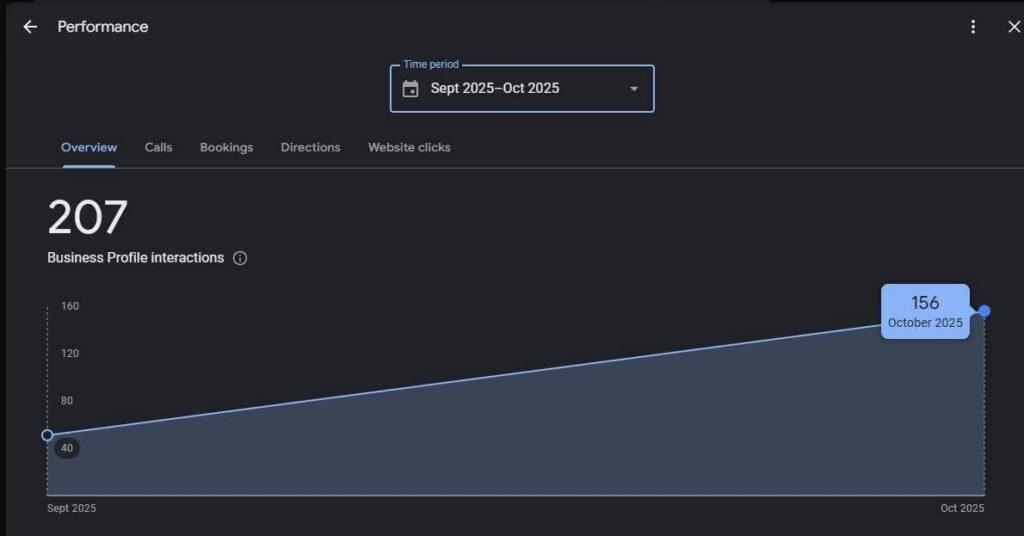
Result: Within 90 days, impressions in Google Maps jumped 190%, and monthly calls increased from 87 to 220. That’s the direct ROI of consistent local SEO work.
How to Build a Winning Local SEO Strategy (Step-by-Step)
Local SEO can seem overwhelming, but success follows a clear process. Here’s a proven framework you can apply to any website, especially local and dental businesses.
Step 1: Conduct Research
Start with audience and keyword research. Understand what people search, not what you think they search.
Use tools like:
- Google Autocomplete
- People Also Ask
- Google Search Console (for existing queries)
- Ahrefs / Semrush (for keyword volume + competition)
Create a sheet grouping keywords by intent:
- Transactional: “Book a dentist near me.”
- Informational: “How often should I clean my teeth?”
- Local: “Best dentist in Birmingham.”
Step 2: Audit Your Site
Run a technical Local SEO audit using Screaming Frog or Sitebulb. Check for:
- Broken links
- Duplicate titles and descriptions
- Slow pages
- Mobile issues
- Missing schema
Fixing basic errors often leads to quick ra main topics (ranking jumps.
Step 3: Create a Topical Map
List your Preventive Dentistry, Cosmetic Dentistry, and Restorative Dentistry. Under each, create supporting articles like:
- “Best toothpaste for sensitive teeth”
- “Teeth whitening aftercare tips”
- “How long do veneers last?”
This structure helps Google understand your expertise and boosts topical authority.
Step 4: Optimize On-Page Elements
Each page should include:
- Target keyword in the first 100 words.
- Compelling title tag + meta description.
- Header hierarchy (H1 → H2 → H3).
- Schema markup for rich results.
- Internal links pointing to related topics.
- Clear CTA such as “Book Appointment” or “Call Now.”
Step 5: Build Backlinks & Mentions
Focus on quality backlinks, not quantity.
Ideas:
- Partner with local blogs or community websites.
- Publish dental health guides and share them with journalists.
- Sponsor local school or charity events (many include links).
- Appear on dental podcasts or webinars.
💡 Pro Tip: Even one backlink from a reputable health blog can outweigh 50 random directory links.
Step 6: Monitor & Adjust
Use Google Search Console and Analytics to track:
- Clicks and impressions
- Average position
- Conversion rate
- Calls from Google Business Profile
Local SEO is never “set and forget.” Review data monthly, identify drops, and keep improving.
Let’s Optimize Your Local SEO the Right Way
From research to backlinks, turn every step into measurable results.
Common Local SEO Mistakes to Avoid
Even experienced marketers make avoidable errors. Here are the top ones that silently kill rankings:
- Ignoring mobile experience – Over 60% of Google searches come from phones.
- Thin content – Pages under 300 words rarely rank well.
- Overusing keywords – Keyword stuffing signals spam.
- No internal linking – Creates orphan pages that Google can’t find.
- Buying backlinks – Risky; can lead to penalties.
- Ignoring analytics – You can’t improve what you don’t measure.
- Skipping title & meta optimization – The first thing users see in SERPs.
Avoid these, and you’re already ahead of 70% of competitors.
Local SEO Myths That Need to Die in 2026
| Myth | Reality |
| “Local SEO is dead.” | Search is evolving, not dying. |
| “Longer content always wins.” | Quality > length; answer intent clearly. |
| “Backlinks don’t matter.” | Still crucial for authority. |
| “Domain Age = Ranking.” | Fresh, optimized sites can outrank old ones. |
| “Duplicate content kills your site.” | Only large-scale duplication harms rankings. |
| “Local SEO is free.” | It costs time, effort, and expertise. |
Technical Local SEO Deep Dive
If Local SEO were a house, technical Local SEO would be the foundation. Without it, everything else collapses.
Site Architecture
Keep URLs short, descriptive, and consistent:
/services/dental-implants/
/blog/teeth-whitening-tips/
Speed Optimization
Use tools like Google PageSpeed Insights. Aim for:
- LCP < 2.5 s
- CLS < 0.1
- FID < 100 ms
Compress images, enable caching, and choose a fast host.
Structured Data
Add schema for:
- Organization
- Local Business
- FAQ
- Review
Schema helps Google show rich results like ratings, FAQs, or business hours.
Secure & Mobile-First
Use HTTPS and test on multiple devices. Google indexes the mobile version of your site first.
On-Page Local SEO Best Practices
Titles & Meta Descriptions
Write titles under 60 characters and meta descriptions under 160. Include your target keyword naturally.
Example:
Title: Teeth Whitening in Dubai – Affordable & Safe Treatments
Meta: Brighten your smile with expert teeth whitening in Dubai. Book your appointment today.
Content Optimization
- Use subheadings for clarity.
- Add FAQs at the bottom of each page.
- Insert internal links using descriptive anchor text.
- Include 1–2 external links to trusted sources.
Images & Media
- Name files descriptively (dental-implant-before-after.jpg).
- Compress for the web.
- Use alt text that describes, not repeats keywords.
Calls-to-Action (CTAs)
Guide users clearly:
“Book Your Appointment,” “Get a Free Consultation,” “Call Now.”
Off-Page Local SEO & Authority Building
Search engines view backlinks as votes of confidence.
But not all votes are equal.
Quality Signals
High-authority backlinks come from sites that are:
- Relevant to your industry
- Have real traffic
- Editorially given, not paid.
Earning Backlinks Naturally
- Publish research or infographics.
- Share success stories or patient education pieces.
- Collaborate with local businesses for cross-promotion.
- Create “linkable assets”: unique guides, tools, calculators.
Brand Mentions & Social Signals
Even unlinked mentions contribute to brand trust.
Stay active on Facebook, Instagram, and LinkedIn to increase visibility.
Real-World Example – How a Local Dentist Ranked #1
Clinic: SmileHub Dental Care Birmingham
Goal: Appear in the top 3 for “emergency dentist Birmingham.”
Steps Taken:
- Built a location-optimized page with schema.
- Added 15 before-and-after images with alt text.
- Gained a backlink from a local news site after a charity event.
- Asked patients for Google reviews immediately after appointments.
- Embedded Google Map on contact page + added directions.
Outcome:
Ranked #1 for the main keyword in 60 days and doubled weekly appointments. Their GBP listing started appearing in People Also Search For sections across other local clinics.
Essential Local SEO Tools You Should Master
Tools make Local SEO measurable, efficient, and scalable. They don’t replace strategy, but they give you data to make smarter decisions.
Here’s a categorized list every beginner should know:
Free Google Tools
Google Search Console (GSC):
Shows impressions, clicks, and errors. It’s your direct line to Google’s understanding of your site.
Google Analytics 4 (GA4):
Tracks user behavior, engagement, and conversions. Check how visitors move across pages, what they click, and how long they stay.
Google PageSpeed Insights:
Analyzes speed and Core Web Vitals. It tells you what’s slowing your site and how to fix it.
Google Business Profile (GBP):
Crucial for local SEO. Helps you track map views, calls, and direction requests.
Freemium Local SEO Tools
Ahrefs / Semrush:
Keyword research, backlink analysis, and competitor monitoring in one place.
Ubersuggest:
Good for beginners. Helps with keyword ideas and content planning.
Screaming Frog:
Crawls your website and identifies broken links, redirects, and missing metadata.
Rank Math or Yoast Local SEO:
WordPress plugins that help you optimize each page for keywords and readability.
Advanced / Technical Tools
SurferLocal SEO:
Analyzes top-ranking pages and gives content optimization suggestions.
Sitebulb:
Excellent for visual site audits, especially for agencies and consultants.
AnswerThePublic:
Shows real-world questions people ask around a keyword, perfect for FAQ or blog ideas.
BrightLocal:
Focuses on citations, NAP audits, and GBP tracking, a must for local businesses.
Tracking, Measuring, and Reporting Local SEO Results
Local SEO isn’t “set it and forget it.”
Tracking performance regularly helps you understand what’s working and what needs attention.
Key Metrics to Track
| Metric | Purpose |
| Organic Traffic | Measures growth over time |
| Keyword Rankings | Tracks position changes |
| Click-Through Rate (CTR) | Shows how attractive your titles are |
| Bounce Rate | Reveals engagement quality |
| Conversion Rate | Tells how traffic becomes leads/sales |
| Backlink Growth | Indicates authority building |
| Local Pack Visibility | Especially for dental/local clinics |
Recommended Reporting Schedule
- Weekly: Check rankings, CTR, and impressions.
- Monthly: Review conversions and backlink growth.
- Quarterly: Full audit, update old pages, fix broken links, and adjust strategy.
Tip: Create visual dashboards in Google Looker Studio (formerly Data Studio) for clients or team presentations.
How to Optimize for AI Search and Voice Search
Search in 2026 isn’t limited to typing. Voice queries and AI overviews are transforming how users interact with search engines.
Voice Search Optimization
Voice queries sound more natural and question-based. Instead of “dental implants cost,” users say:
“How much does a dental implant cost in Dubai?”
To optimize:
- Add FAQs with conversational phrasing.
- Use schema markup for Q&A and how-to.
- Focus on long-tail, question-based keywords.
Generative AI & GEO (Generative Engine Optimization)
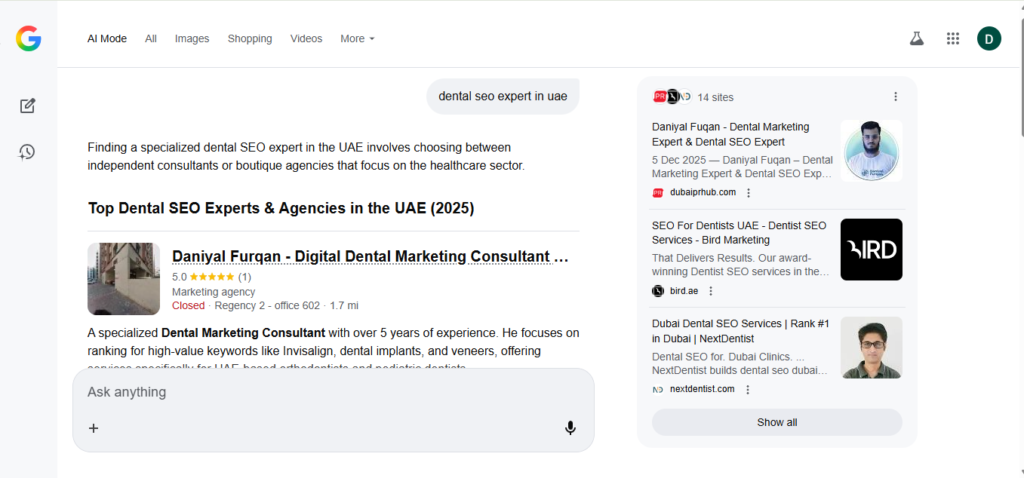
Generative AI (like ChatGPT, Perplexity, Google AI Mode, or Google’s AI Overviews) now summarizes results directly. That means your content must be easy to quote and credible.
How to prepare:
- Write clearly and factually.
- Use bullet lists and short sentences.
- Cite real sources and data.
- Add author bios to boost trust.
If AI tools use your content for summaries, that’s free brand visibility and authority.
The Future of Local SEO in 2026 and Beyond
Local SEO never stays still; it evolves with technology and human behavior. Here’s where it’s heading:
AI and Machine Learning
AI already helps search engines interpret context better. In 2026, ranking will depend more on topic authority than exact keywords.
Example:
If your dental site consistently covers oral hygiene, cosmetic dentistry, and preventive care, you’ll automatically rank for related new keywords.
Experience (E-E-A-T) Becomes Non-Negotiable
Google rewards content that shows Experience, Expertise, Authoritativeness, and Trustworthiness. Show it by:
- Adding author credentials and bios.
- Publishing real client results.
- Using genuine data and case studies.
- Keeping your About and Contact pages visible.
Zero-Click Searches Will Rise
AI overviews and snippets will continue to reduce clicks. To win visibility, structure your content for featured snippets, FAQs, and lists. Even if users don’t click, your brand gets exposure.
Local Search Personalization
Search results are becoming hyper-localized. Two people on the same street can see different map results. That’s why local SEO (especially for dental clinics) will remain the top ROI channel for service businesses.
Sustainability and Accessibility
Google’s new web standards value sustainable and accessible websites. Fast-loading, energy-efficient, and inclusive sites will have an edge.
Make sure your website:
- Has alt text on all images.
- Uses readable color contrasts.
- Loads fast on low-speed connections.
- Avoids heavy popups or autoplay videos.
Local SEO FAQs
Q. How long does Local SEO take to work?
Most websites see visible improvement in 3–6 months, depending on competition and consistency.
Q. What’s better for local clinics, Local SEO or paid ads?
Local SEO builds long-term trust. Ads bring instant results. A smart mix of both is ideal.
Q. Do I need backlinks to rank?
Yes. Backlinks remain a core ranking factor. Focus on relevant, high-quality ones.
Q. How many words should a Local SEO article have?
There’s no magic number. Aim for depth, not length. Cover the topic fully and naturally.
Q. Can I do Local SEO myself?
Yes, but it takes time to learn. You can start with basics like meta tags, internal linking, and content updates.
Q. What are Google’s Core Web Vitals?
Metrics that measure site speed and user experience: LCP, CLS, and INP.
Q. Is schema markup necessary?
Highly recommended. It helps search engines understand your content and can increase CTR with rich snippets.
Q. What are “orphan pages”?
Pages with no internal links pointing to them, Google struggles to find them. Always interlink new pages.
Q. How often should I update my website?
Update key pages every 3–6 months. Check titles, links, and statistics for freshness.
Q. What is E-E-A-T in Local SEO?
It stands for Experience, Expertise, Authoritativeness, and Trustworthiness, Google’s core content quality signals.
Q. Does social media help Local SEO?
Indirectly yes. It drives brand searches and backlinks.
Q. What’s a canonical tag?
It tells Google which version of a page is the main one, avoiding duplicate content issues.
Q. Is HTTPS mandatory for ranking?
Yes. Sites without HTTPS are flagged as insecure and may lose trust signals.
Q. Can AI-generated content rank?
Yes, if factually correct, edited by humans, and genuinely helpful.
Q. How do I track local SEO performance?
Use Google Business Insights + Search Console + BrightLocal to monitor map views, calls, and directions.
Q. How often should I post on my blog?
Once a week is great for consistency, but quality always beats quantity.
Q. Do images help Local SEO?
Absolutely. Optimized images improve engagement and can appear in image searches.
Quick Local SEO Checklist (Printable Summary)
Technical
- HTTPS enabled
- Fast loading (under 2.5s)
- Mobile responsive
- Indexed pages confirmed in GSC
On-Page
- Target keyword in title and H1
- Compelling meta description
- Internal and external links
- Schema markup
Content
- Focus on search intent.
- Include visuals and FAQs.
- Add E-E-A-T signals
- Update quarterly
Off-Page
- Build backlinks gradually
- Earn local citations
- Manage GBP reviews
- Promote content on social.
Tracking
- Monitor rankings weekly
- Audit site quarterly
- Measure calls and conversions monthly
Local SEO in 2026: Mindset Over Mechanics
The technical side of Local SEO will always evolve. Algorithms will change. Tools will come and go. But the mindset remains constant: help users first, and rankings follow.
When you create something that genuinely improves the user’s experience, Google’s algorithms eventually catch up.
Focus on:
- Clear communication
- Honest branding
- Useful, factual information
- Real local value
Whether you’re optimizing a dental clinic, a home service business, or a personal portfolio, the rule is the same: trust drives traffic.
Final Thoughts
Local SEO in 2026 is smarter, fairer, and more competitive. It’s no longer about shortcuts; it’s about building meaningful digital footprints.
If you remember one thing from this guide, let it be this: Visibility follows value.
Build a website that loads fast, answers real questions, and earns trust. Stay consistent with your content, monitor your progress, and adapt to trends like AI Overviews and voice search.
That’s how you future-proof your online presence, and that’s how I’ve helped countless local and dental clients dominate their city searches.
Now it’s your turn. Start optimizing today because every day you delay, someone else takes your spot.
Turn Local Visibility into Real Revenue
Strong Local SEO means more calls, visits, and booked appointments.
Author Bio

Written by: Daniyal Furqan
Intro: I am a dental marketing expert and consultant in the UAE, USA, UK, and Pakistan. I am helping dentist increase their patient ratio and invisalign sales.
Experience: 4.5 years of experience in Dental SEO and dental marketing…
Website: https://daniyalfurqan.com
My Thoughts: “Local SEO isn’t about gaming algorithms, it’s about understanding people.
Help them find what they need, and Google will help them find you.”